top of page
The master
The mystic
The wit
Red Library.png
Protect original thought.

Before there was Copycat, the Narrative Agency, there was Copycat Copywriters. Borne of a screenwriter's bullpen, our first conception of content marketing was simple: dazzle them with literary brilliance. Build irresistible copy. 


Over time, Copycat became synonymous with scalable writing teams. 


Yet right at the apex of our growth, more certain of our identity than ever, digital marketing did a backflip. 


Given that most agencies adhered to the “tried-and-true playbook,” relying on templated assets and formulaic content, the advent of AI language models only served to accelerate the core problem. Noisy channels grew nosier. Empty content felt emptier. Marketing became increasingly impersonal. 


Then someone finally shouted “back to brand” and everyone started running. 


When the dust settled—the playbook now trampled—many companies were forced to ask themselves: what brand? 


While all this was happening, we were still operating in the background. Trying to understand how this “playbook” was ever celebrated in the first place and sharpening our philosophy in the process.

Our take is relatively simple: 

1

Consumers are intelligent and trust is hard-earned. That’s why novelty wins, transparency is non-negotiable, and communications must start from the inside out (honestly, it’s honesty). 

2

People understand the world—and themselves—through stories. That’s why brands require an underlying narrative that aligns internal employees and captivates audiences.

3

Communities move mountains. That’s why rallying your audience around authentic, impassioned leaders and owned media is such a powerful strategy for growth.

Early on in this development, we knew “Copywriter” was no longer a term that suited us. Yet, we didn’t want to join the world of “Marketing Strategists”—to be honest, that gives us the ick (no offense).


But to hone the craft that allows us to create Strategic Narratives, we had to go back even further. Before Copycat Copywriters, even. When we were young, aspiring writers lost in our notebooks listening to Save The Cat, reading Bird by Bird, and rewriting our “art house” screenplay for the 17th time. 


We had to call upon the fundamentals of fiction to breathe narrative into an industry that traded creativity for data. To help brands co-create a narrative worth believing in. 


Because at the end of the day, consumers deserve authentic, meaningful content. 


And brands deserve to feel confident in everything they create.

Introducing the cats

Head of Editorial

Nicky Hatzidimitriou

strategic polisher of prose, poetic observationalist, and proud orange cat mom.

Originally from Baltimore, MD, Nicky started her career in NYC working in TV production. After six years, she moved to LA in search of a palm tree-dappled landscape and a more writing-centric career. Happily, she's found both. When she’s not creating narrative-driven content with The Cats, she’s working on her latest screenplay or dreaming up poems about love.

Lead Narrative Strategist

Hailey Kragelj

technical publications writer, em-dash enthusiast, and Broadway’s most prolific patron (unofficially).

After graduating from USC with degrees in Theatre and Narrative Studies, Hailey was often asked, especially of the latter, “What will you DO with that?” At the time, she didn’t know either. Now, it’s obvious: join a ragtag group of creative copywriters, wait for AI to implode the industry, and build Copycat into a Narrative Agency to be reckoned with.

Director of Operations

Kevin Lisowski

incisive problem solver, expedition backpacker, and fearless hurling goalkeeper.

Kevin started his first business at 13 with a borrowed lawnmower and a handful of nickels for the copy machine. He was a part of several wonderful failures and as many horrible successes. Those situational dichotomies taught him impactful lessons that continue to influence his leadership and management style years later.

Founder & CEO

Shawn Rolph

novel communicator, emo music spokesperson, awkward boxer that finds beauty in small spaces.

When Shawn first started Copycat, he did not know he was starting Copycat. All he wanted to do was write poetry with spellbent creatives, clairvoyant authors, and afternoon buskers beneath pine trees. To weave meaning in a knowledge base of word spam. But they decided to pay him for it. And so here we are.

Mikey.png
President

Mikey Shaughnessy

architect of systems, serenader of trees, and bringer of Friday energy on a Tuesday.

Somewhere on a spectrum between the aftertaste of gas station coffee and the steam rising off a Nordic spa lies Mikey’s spiritual compass. Though sometimes leading him off a 60-foot cliff (literally), it usually guides him toward being a better human—whether that’s learning the piano, communing with nature, or architecting a new system at Copycat.

Project Manager

Laura Winnemann

creator of efficient processes and workflows, creative problem solver, and planner of all family vacations.

Laura’s roots are in project management for live events. After 10 years, Laura decided to shift industries into project management for Marketing and Tech. She soon took on the role of Scrum Master, where she learned to love all things agile. She spends her free time being a mom, reading, and drinking coffee.

Curious to meet more cats?
Eager to join these cats yourself?
Red Library.png
Protect original thought.

It started as an off-hand comment… protect original thought.


It was something we said internally, encouraging one another to think beyond strategies that mirrored the typical marketing playbook. 


Even before AI, we were hyper-aware that one-size-fits-all strategies, channel “best practices,” and the industry standard advice of copy your competitor would never create an environment where Founders and their teams are empowered to find their unique voice. 


But when large language models crawled onto the scene and expanded the echo chamber with empty, lifeless content, this problem could no longer be ignored. Put simply?

The marketing playbook f*cked everything up. 

Today, companies struggle to keep up with marketing demands. To break through the tsunami of content. To find a unique strategy that both sets them apart and draws customers in. 


They’re left in the same room as their competition, with the same little rulebook, with the same script, competing for the same few customers who are exhausted from listening to them. 


Original thought is teetering at the cliff’s edge. Tradition is encouraging it to jump

Protect original thought from an industry hell-bent on killing it.

Overnight, our simple phrase became an anthem—a rallying cry for companies who were seeking different, seeking better. 


Our first product—Brand Narrative—focused on helping companies tell a more effective story in their marketing campaigns. But our work was quickly adopted into sales scripts. Then website rebrands. Then employee handbooks.


We spent the last two years shaping our second product—Strategic Narrative—to more deliberately address the problems we were seeing cross-industry:

→ Founders couldn’t get stakeholders, colleagues, and peers to tell the same story of the company

→ Sales and marketing teams were consistently struggling to break through and find their lane

→ Team morale frayed when not aligned around a clear vision 


Strategic Narrative is our magnum opus, a product that weaves a brand’s unique qualifications, values, and POV into a story that’s actually capable of:  


#1 Realizing their unique growth strategy through differentiation 

#2 Improving sales conversations and customer resonance 

#3 Aligning a team around a vision and ethos 

#4 Empowering stakeholders, colleagues, and peers to articulate and pitch the company


Somewhere in the era of data worship, companies forgot that without concerted effort, their story will fragment across channels, slip from the minds of their colleagues, and lose its integrity. 


But the answer—we believe—comes back to the one thing that unites us all: original thought.


Companies who speak their irrefutable truth will find people who are desperate to hear it.


As the only way to break through is to be unapologetically, irresistibly you.  


And in doing so, create a playbook that actually fits your brand’s unique, beautiful complexities. 


This is why Copycat exists. 


This is why the world needs a narrative agency.

Take control of your narrative.
Red Library.png
Protect original thought.

It started as an off-hand comment… protect original thought.


It was something we said internally, encouraging one another to think beyond strategies that mirrored the typical marketing playbook. 


Even before AI, we were hyper-aware that one-size-fits-all strategies, channel “best practices,” and the industry standard advice of copy your competitor would never create an environment where Founders and their teams are empowered to find their unique voice. 


But when large language models crawled onto the scene and expanded the echo chamber with empty, lifeless content, this problem could no longer be ignored. Put simply?

The marketing playbook f*cked everything up. 

Today, companies struggle to keep up with marketing demands. To break through the tsunami of content. To find a unique strategy that both sets them apart and draws customers in. 


They’re left in the same room as their competition, with the same little rulebook, with the same script, competing for the same few customers who are exhausted from listening to them. 


Original thought is teetering at the cliff’s edge. Tradition is encouraging it to jump

Protect original thought from an industry hell-bent on killing it.

Overnight, our simple phrase became an anthem—a rallying cry for companies who were seeking different, seeking better. 


Our first product—Brand Narrative—focused on helping companies tell a more effective story in their marketing campaigns. But our work was quickly adopted into sales scripts. Then website rebrands. Then employee handbooks.


We spent the last two years shaping our second product—Strategic Narrative—to more deliberately address the problems we were seeing cross-industry:

→ Founders couldn’t get stakeholders, colleagues, and peers to tell the same story of the company

→ Sales and marketing teams were consistently struggling to break through and find their lane

→ Team morale frayed when not aligned around a clear vision 


Strategic Narrative is our magnum opus, a product that weaves a brand’s unique qualifications, values, and POV into a story that’s actually capable of:  


#1 Realizing their unique growth strategy through differentiation 

#2 Improving sales conversations and customer resonance 

#3 Aligning a team around a vision and ethos 

#4 Empowering stakeholders, colleagues, and peers to articulate and pitch the company


Somewhere in the era of data worship, companies forgot that without concerted effort, their story will fragment across channels, slip from the minds of their colleagues, and lose its integrity. 


But the answer—we believe—comes back to the one thing that unites us all: original thought.


Companies who speak their irrefutable truth will find people who are desperate to hear it.


As the only way to break through is to be unapologetically, irresistibly you.  


And in doing so, create a playbook that actually fits your brand’s unique, beautiful complexities. 


This is why Copycat exists. 


This is why the world needs a narrative agency.

Take control of your narrative.

Curious to meet more cats?

Eager to join these cats yourself?

Red Library.png

The master

You know Copernicus, yeah? They call him the father of modern astronomy. But before his heliocentric model was proven right, they just called him crazy.


We know that any strategy worth its salt requires a clear narrative at its core. Now we’re waiting for the rest of the world to catch up.

The mystic

There’s nothing otherworldly about our work. We listen closely, approach with curiosity, and let the most important pieces rise to the surface. We fit them together thoughtfully, using the science of storytelling, to form your irrefutable narrative.


But if it feels like divine intervention, well, who are we to break the spell?

The wit

Why communicate, if not to delight, surprise, inform, amuse? 


As language aficionados and downright joyful people, we string our words together as an act of love, a play for connection. After all, this isn’t rocket science. We’re not actually comparing ourselves to Copernicus, alright?

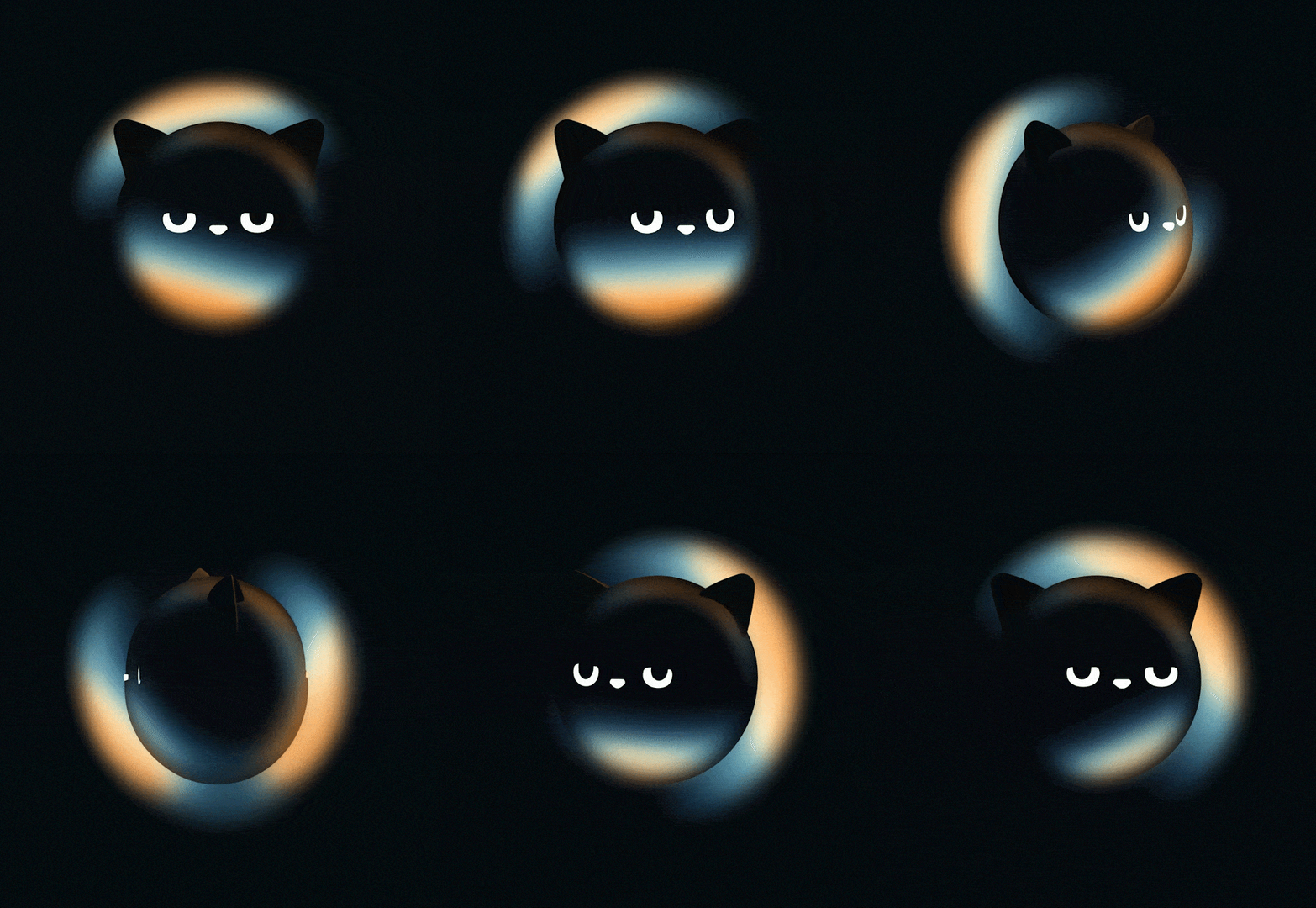
Oh, did you catch that? At the top of the page? That’s our brand character. The spirit of Copycat.

The master, the mystic, the wit—who’s that?

Can we just grab a coffee?

Whether you want to shoot the breeze, ask us for book recommendations, explore a potential partnership, or wax poetic about the state of the industry, our line is always open.

Introducing the Narrative Agency.

Before there was Copycat, the Narrative Agency, there was Copycat Copywriters. Borne of a screenwriter's bullpen, our first conception of content marketing was simple: dazzle them with literary brilliance. Build irresistible copy. 


Over time, Copycat became synonymous with scalable writing teams. 


Yet right at the apex of our growth, more certain of our identity than ever, digital marketing did a backflip. 


Given that most agencies adhered to the “tried-and-true playbook,” relying on templated assets and formulaic content, the advent of AI language models only served to accelerate the core problem. Noisy channels grew nosier. Empty content felt emptier. Marketing became increasingly impersonal. 


Then someone finally shouted “back to brand” and everyone started running. 


When the dust settled—the playbook now trampled—many companies were forced to ask themselves: what brand? 


While all this was happening, we were still operating in the background. Trying to understand how this “playbook” was ever celebrated in the first place and sharpening our philosophy in the process. 


Our take is relatively simple:

1

Consumers are intelligent and trust is hard-earned. That’s why novelty wins, transparency is non-negotiable, and communications must start from the inside out (honestly, it’s honesty).

2

People understand the world—and themselves—through stories. That’s why brands require an underlying narrative that aligns internal employees and captivates audiences.

3

 Communities move mountains. That’s why rallying your audience around authentic, impassioned leaders and owned media is such a powerful strategy for growth.

Early on in this development, we knew “Copywriter” was no longer a term that suited us. Yet, we didn’t want to join the world of “Marketing Strategists”—to be honest, that gives us the ick (no offense).


But to hone the craft that allows us to create Strategic Narratives, we had to go back even further. Before Copycat Copywriters, even. When we were young, aspiring writers lost in our notebooks listening to Save The Cat, reading Bird by Bird, and rewriting our “art house” screenplay for the 17th time. 


We had to call upon the fundamentals of fiction to breathe narrative into an industry that traded creativity for data. To help brands co-create a narrative worth believing in. 


Because at the end of the day, consumers deserve authentic, meaningful content. 


And brands deserve to feel confident in everything they create.

Red Library.png

The master, the mystic, the wit—who’s that?

The master

You know Copernicus, yeah? They call him the father of modern astronomy. But before his heliocentric model was proven right, they just called him crazy.


We know that any strategy worth its salt requires a clear narrative at its core. Now we’re waiting for the rest of the world to catch up.

The mystic

There’s nothing otherworldly about our work. We listen closely, approach with curiosity, and let the most important pieces rise to the surface. We piece them together thoughtfully, using the science of storytelling, to form your irrefutable narrative.


But if it feels like divine intervention, well, who are we to break the spell?

The wit

Why communicate, if not to delight, surprise, inform, amuse? 


As language aficionados and downright joyful people, we string our words together as an act of love, a play for connection. After all, this isn’t rocket science. We’re not actually comparing ourselves to Copernicus, alright?

Here's a hot take:
Let's just grab coffee

Together, let’s solve your most pressing content problem, commiserate about the rise of robots, or collaborate on upcoming creative.

If you want to shoot the breeze, ask us for book recommendations, explore a potential partnership, or wax poetic about the state of the industry, our line is always open.

bottom of page